Friday, August 10, 2007

Watching Harry Potter and the Order of the Phoenix (David Yates, 2007)


I've never been a fan of the Harry Potter films. What I love and appreciate about the books - the complexity of the plot and certain characters - just never seems to be conveyed in the films. And when I heard that the last film, Order of the Phoenix is actually the shortest of all filmed so far, whereas the book is the longest, I already thought I might not like it.

But I do have to admit, that for the most part of the film, they really summed up the story nicely - they kept to the books, left some stuff out, but what they kept was mostly true to the books and I was relieved they weren't compelled to change anything or just make it up, like they did with many things in the previous films.

I do understand that they try to make these films attractive and interesting to watch, but what they don't realize is that sometimes they really do exactly the opposite of what is in the books, which does really annoy me. For example: in the books much time is spent on how vitally important it is that Muggles don't see wizards doing wizarding stuff (like flying on a broomstick), yet what they do in the film - insert a full scene where the Advance Guard flies with Harry right over the Thames and very close to some boats - exposed, in full view of Muggles.

Quite a bit of time is spent on the DA and Umbridge (who, by the way, is just superb!), but they also manage to mention how powerful a witch Ginny is becoming and they hint more heavily at what's going between Hermione and Ron; even give a tiny bit of a hint as to Neville's past. They have the time to deal with Harry's first love interest, Cho and give some screen time to Grawp, Aberforth and Kreacher. They have Luna also, which is just fantastic - the young actress nails Luna's character. (Something of a lesson to the actors of the trio!)

I really disliked that they cut the end, which is the most important thing in the book, short (a feat they did with Goblet as well). In fact everything was happening very fast and I wonder whether a person who hasn't read the books would have a clue as to what was going on at all.

Again, Dumbledore was abysmally acted (he sure has energy and drive, but none of Dumbledore's politeness and diplomatic ways), and despite many praises from other reviewers I really disliked Bellatrix. She was too twisted for my taste. I have never seen her (in the books) as someone who is off her rocker. Yes, she has made a decision for a life-long devotion and service to Voldemort, but that doesn't make her crazy by default. I think Helena Bonham Carter missed with this role.

In general, I wouldn't have seen this one if boyfriend wasn't keen on going to the cinema. And as of now, I have no intention of seeing the last two films, either.

Labels: ,

posted by Nadezhda | 09:51 | 0 comments

Sunday, July 01, 2007

Elizabeth, The Golden Age

I'm fascinated by the new trailer for Elizabeth. Judging from what I can see, it's going to be a smashing film. September cannot come too soon! And I can only wish that Blanchett's performance is powerful enough to re-claim her the Oscar she was stripped of in 1998 (Gwyneth Paltrow won then).

The new trailer


The old trailer

Labels:

posted by Nadezhda | 13:02 | 7 comments

Friday, November 24, 2006

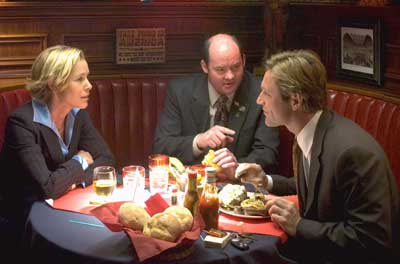
Watching Thank you for Smoking (2005, Jason Reitman)


What a night, what a film - a good laugh every five minutes! (This is one of the 4 films I saw on Liffe this year.)

The film is an adapted version of a book I haven't read, so I cannot comment on how very alike the two versions are. However, the film does stand on its own and is hillarious.

We all know smoking is harmful and has long-term negative effects on health and well-being. The autor, however decided to look on the matter from a different perspective. What happens if someone gets paid to directly promote (not as in advertizing) smoking?

It is not such an irational concept. Just think about it. There are plenty of jobs in the tobacco industry, so what if someone was employed by the "big tobacco" to constantly question what other people consider as a solid truth? What if he always asked "Is your mom a researcher or a doctor?" when a little girl says her mother told her smoking is bad for your health. What if he came up with ingeniously crafted rethorical questions when someone claimed that tobacco companies are selling poison. This is what Nick Naylor (wonderful acting - very persuasive - on the part of Aaron Eckhart) does.

When people accuse the big tobacco companies of selling harmful products that could lead to premature death, he says "Why would the tobacco companies want to kill their customers?" Like all good corporations, he focuses on money. What Nick Naylor does is question what most people consider solid truths. He claims that when you question something and by questioning it proove that your opponent's claims do not hold water, you win automatically. The fact that you might also be wrong, doesn't even matter. It matters that you win and they lose.

Nick doesn't even have problems spreading this theory of his among his acquaintances (the M.O.D. - Merchants of Death - squad). In his own words: "My job requires a certain... moral flexibility." However, the situation becomes more complex, when Nick's young son, Joey, starts to accompany Nick on his business trips. Now it's not only about Nick's moral "flexiblitiy" but about the message he's sending to his son.

I have no intentions of spoiling the ending for you, so I'll stop summarizing the plot. But even if you already know what the film is about, it's a delight to watch. Partly because of Eckhart's competent acting, partly because of the humour that permeats every pore of the script. I highly recommend it as a longer break from studying, especially when you have to study on a lousy Friday night.

As an appetizer, let me introduce you to BR, Nick's boss: "People, what is going on out there? I look down this table, all I see are white flags. Our numbers are down all across the board. Teen smoking, our bread and butter, is falling like a shit from heaven! We don't sell Tic Tacs for Christ's sake. We sell cigarettes. And they're cool and available and *addictive*. The job is almost done for us!"

Labels:

posted by Nadezhda | 12:35 | 2 comments

Saturday, October 28, 2006

Films I'm going to see this Autumn

Went to buy tickets for Liffe yesterday and was a little disappointed. I had hoped they would at least bring The Queen to Ljubljana, not to speak of Marie Antoinette, but was very much mistaken. As it is now, I'm going to see Volver, Babel and A Prairie Home Companion. And I'm going to see An Inconvenient Truth at the cinema in a few days' time.

At least that's something... even though I've been longing to see The Queen. Should have seen it while I was in London - serves me right for being such a tight-fisted person so as to deem the cinema tickets there too expensive!

Labels:

posted by Nadezhda | 11:09 | 5 comments

Sunday, October 22, 2006

Films I'd like to see this Autumn


Volver - gotta love Almodovar (and Cruz in Almodovar's film),

Babel - mainly because I'm secretly in love with Cate Blanchett and because I like intertwining life-stories,

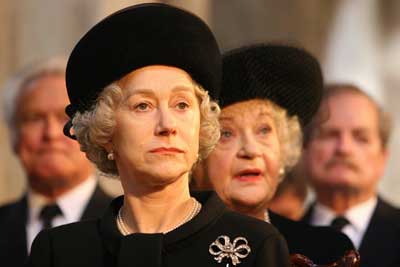
The Queen - superior in so many ways and Hellen Mirren as the most valuable of the film's assets,

An Inconvenient Truth - after the documentaries about Bush, fast food and killings in high-schools wormed their ways into (mainstream) cinemas, now it's finally the time to be shocked at what we're doing to ourselves,

The Departed - mainly on boyfrined's urging, but the cast is superior and I'd like to see what they've produced;

Marie Antoinette - even though the critics have torn it apart I'm still willing to see it, because I like Coppola's fresh take on a historical figure, and then I'll make up my mind;

The Prestige - I like the cast and am intrigued by the trailer.

Also, I hope The Golden Age is ready to be relased soon - I'm ecstatic just thinking about Cate Blanchett reprising her role. And this time, if the film's any good, she better get that Oscar she was so infamously deprived of in 1998!

Labels:

posted by Nadezhda | 12:43 | 4 comments

Sunday, September 17, 2006

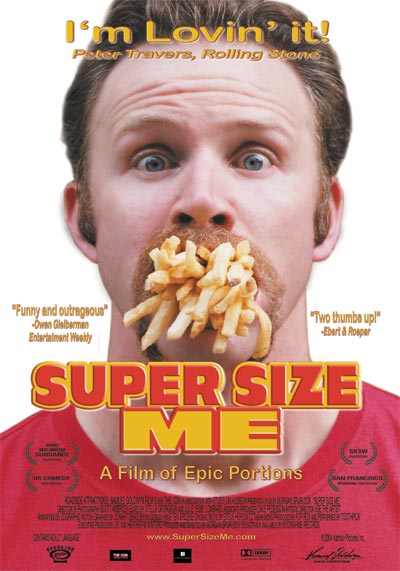
Watching Super Size Me (Morgan Spurlock, 2004)


Yesterday boyfriend and I decided to watch Super Size Me. We knew the film was a documentary about the adverse effects of fast food, but were pleasantly surprized to discover it was more than just that.

Morgan Spurlock, a 33 year-old American from Manhattan in New York is flabbergasted to discover the epidemic proportions of obesity in America, where 2 out of 3 adult people are overweight or obese and omnious 37% of children and adolescents have too high percentage of body fat. When he learns about the case of two teenage girl suing McDonald's for not having informed them that they could become obese by eating their food on a regular basis, Spulock begins to wonder where personal responsibility ends and corporate responsibility begins. He decides to undergo a 30-day long experiment to prove (or disprove) the adverse effects of a McDonald's diet on health, combined with as much (or better said as little) exercise as a middle-of-the-norm American gets per day.

He starts out as an above-average healthy American and consults various doctors, life-style, nutrition and fitness experts. Nobody thinks a 30-day experiment could harm him, the doctors presume only his serum level of triglycerides (fats from food) will rise. However, as early as in 12 days' time, the results of Spurlock's blood tests are so bad as to shock everybody.

Admittedly, Spurlock's experiment was a bit extreme in that most people don't eat solely (= three times daily) at fast food joints. However, even though the time span of the experiment was shorter than the time an average American would need to eat the same amount of fast food, Spurlock's conclusions are far from being invalid. It is very important to note the physiological (weight gain, sharp rise in serum levels of cholesterol) and psychological (mood swings and lethargy) effects this kind of food has on a person and other deleterious effects on the cardiovascular and gastrointestinal systemsm (especially with prolonged consumption of such foods).

Spurlock doesn't shy away from themes like brand imprinting of children - getting young children to remember a brand so that they will buy it when they grow up - (in fewer words: get them while they're still young&naive) and the fact that the fast food industry isn't about well-being of their consumers, but like any other industry - about money. He points out a few facts; namely that very few people have any idea of the amount of energy (from food) they need per day and even less idea about the caloric content of the food they eat. Needless to say, McDonald's joints featured in this film don't hold many (or any) nutritional value factsheets. Also, in a country where the only people who walk are those who can't afford a car, where seemingly any form of exercise is considered an unneeded effort and where nobody has time to exercise, but has the time to watch every concievable reality show -- the rate of obese people hardly comes as a surprize.

Overall, I would heartily recommend viewing of this film to the young mothers and young consumers who claim that McDonald's serves as good meals as one could cook at home or get. And before you start throwing things at the computer screen, calculate the value of your last McMeal here.

So, when was the last time you ate at a fast-food joint?

Labels:

posted by Nadezhda | 13:41 | 6 comments

Friday, September 08, 2006

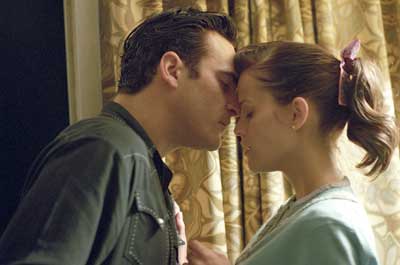
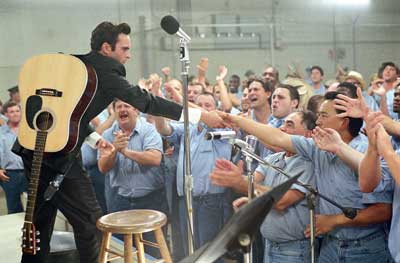
Watching Walk the line (2005, James Mangold)

Walk the Line is much like Ray (2004); an inspirational and uplifting film about a young country musician Johnny Cash, who struggles to make ends meet. And when he does, when he exceeds the expectations and becomes very famous, he realizes that fame isn't convenient in all respects. Additionally, it is a film about the power of enduring love; a film about the struggles of two people over the span of thirteen years, who knew they were right for each other, but it was not meant for them to be united before that long time passed.

The core of the film are Cash's beginnings and his early career, briefly even his childhood, and his growing love for June Carter, a woman who he could not have. From the first moment of their meeting it becomes painfully obvious that they were very impressed with each other, but the circumstances prevented any serious attachment. As Cash's relationship with his first wife grew colder and distant, the more his love for June increased.

By the time half of the film had passed it's blatantly obvious that Johnny's fallen for June with all he is; - he is desperate to show her the love he feels for her, but she remains unmoved by his open (and sometimes embarrassing) displays of affection. Also amidst his addiction-induced erratic behaviour and a busy career, he's hard put to profess his love to her in a way, which would tempt her to accept him. Carter's main reason to hold back in her love for Johnny was her second divorce – in those times still considered a big sin – she'd gone through two marriages, but both unfulfilling and unhappy and she struggles to keep her calm in a world that judges her harshly for being disappointed in love – and twice! Carter, however, is very in touch with her feelings and has long since realized that against all odds she's fallen for her (admittedly much flawed) prince.

The film portrays Cash as a person who never had much, but what he did have was the ability to keep going, even when the odds were against him, even when his personal life was unsteady and he unhappy. When he was emotionally at his all time low (trapped in an unfulfilling marriage, because his first wife wouldn't divorce him, but not in the least bit spared the rampant jealousy his wife displayed), he was still writing new songs and releasing new albums. (At a private viewing of the film, Cash's oldest daughter complained that her mother never was so crazy and mean and that the film's portrayal is unfaithful to the real Vivan Liberto Cash who was a very private, family oriented person.)

Very early in his career, Cash developed problems with substance abuse and for a great part of his carrer, drugs (uppers) were his only faithful companion. He had a relapse in his later years, which goes to prove that an addict is never really cured.

The title for the film comes from Cash's song I Walk the Line, which was originally written for Cash's first wife, Vivian, and not June as the film implies. There are other instances in the film where the script-writers have adapted and modified events to suit their way of telling this story. For instance: Cash was a musician already in High School, when he played on the local radio and he formed his first band while stationed in Germany. The film seems to suggest that Cash likes a shiny new guitar and buys it without so much as any previous knowledge of music. The film also never comes even close to establishing that June Carter Cash was herself addicted to amphetamines in her high school years, thus failing to underline the fact that when Johnny was struggling to get clean, June was able to be of most assistance to him, because she had walked that path before him. June reportedly found great support in her family and thus tried to form a protective and caring net around Johnny as well. Also, Johnny's brother Jack was on his death-bed for a week, before he passed away and the film suggests a different course of events. Such prolonged suffering could have (believably) affected Johnny far more than Jack's quick passing the film portrays. In the film, Johnny's father seems to blame his son very severely for the death of his older and much more loved brother however, in reality it remains a mystery whether Cash's father openly blamed any individual for the death. Nevertheless, it was an event that deeply marked Cash, even into his adulthood and quite possibly instilled in him low self-esteem (his life-long problem). There is also a short scene where Cash's first wife talks about another baby being on the way, when in reality their second child wasn't born until three years later. (It might be that the film-makers tried to add a different edge to the scene or there might have been a miscarriage.)

Overall, a delightful film (I would have never assumed I would like a single, not to speak of several country songs) with superb performances by the leading two actors - while Witherspoon creates an emotional background and a worthy object of affection, Phoenix delievers much of the energy and feel that was typical of Cash. Viewing highly recommended.

Labels:

posted by Nadezhda | 19:21 | 2 comments

Thursday, August 10, 2006

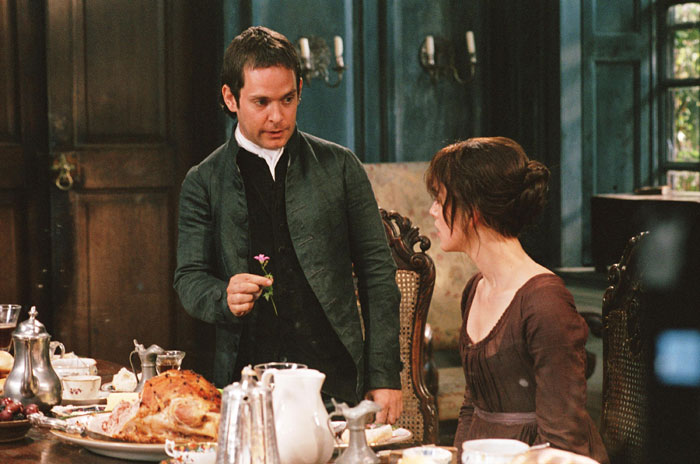
Watching Pride and Prejudice (2005, Joe Wright)

I was fighting long and hard and eventually the alter-ego part of me that wanted a final proof of Keira Knightley's abyssmal acting abilities (you know the story: just another talentless but beautiful young actress) got the better of me. However, I was up for very enjoyable two hours. Please join me in scrutinizing all the aspects of the film.

The first thing one notices in the film is that the film-makers have taken much liberty with the material at hand. It's an adaptation rather than a film version of the book. In the book the Bennets do have a farm, but it is not physically connected to their house. The film makes the village a completely rural place that is considerably less sophisticated than the town, which is a gross over-simplification. Whether the script-writer and director thought that the modern cinema-goer is unable to understand the distinction between the lower and higher class (as it was in Austen's day) is anyone's guess. One of the most powerful messages Austen conveys with her writing is that rank counts for nothing when it is not refined by extensive improvement of the mind. This is underlined by the fact that e.g. Lady De Bourgh is very self-centered and simple-minded despite her elevated rank, extensive property and superb connections.

Also Lizzy and Jane's manners with their incessant giggling do point out the fact that they're very vivacious and young, but they almost fail in establishing the difference between them and the rest of their family. Their manners hardly ever appear sufficiently dignified (even less so with Lizzy's wandering about Darcy's home and her listening at the door) and at times their laughter isn't only unguarded but downright rude. Whether this is a sign of the producers' lacking understanding of the manners of the day or their desperate attempt to make the film likeable among the modern audiences is beyond me. (Additionally: the books are still widely enjoyed and immensly popular just as they are, with their old-fashioned manners and extreme politeness, so why would one establish that the material needs to be modernized?)

Some cuts, naturally, were expected when you're making a 300 page novel into a two-hour film and they somewhat improved the film, for example having Bingley have only one sister worked very well, but the downside is that for a newbie, the plot and all its twists and turns are hard to follow and at moments the actions of certain characters seemed feebly motivated, just because the film-makers could not afford the time to offer extensive explanations. The pace of the story is incredible - and it's not always a good thing to do this in a romance. Surely, an action film benefits from pacing, because it builds suspense, but here some of the scenes were rushed and failed to create a sufficient impact. Jane Austen's writing is universally liked and admired because of the characters she portrays and the wit with which their personalities are described; a six-hour mini series has a definite advantage over the film, simply because it has more time to establish the characters.

But by cutting the plot they left out many interesting characters, violently adapted the scenes and degraded the language to suit the understanding of the regular "pop-corn-fun" movie-goer.

While Mr. Collins was decently portrayed, I felt he was not absurd, over-bearing and pompous enough to be thoroughly disliked. Generally, the acting was good, but I didn't have high expectations, so it easier to be satisfied. I can claim that Knightley (Elizabeth) is a far better actress than I estimated her to be, although I don't think the Oscar nomination was completely in place - this, afterall is an award for outstanding achievement in the field - not for doing your job properly for a change. Macfadyen (Darcy) improves on you once you see him in action, although the change in his feelings (with regard to Elizabeth) is not as pronounced as it should be. But there are evident early symptoms of his affection for Lizzy, which I liked, because it gives enough of a hint to the audience to keep its interest. I especially liked Donald Sutherland as the father, Brenda Blethyn as the mother and Simon Woods as Bingley, who in my opinion is the first to really capture Bingley's amiable, warm, but easily persuaded nature.

The film boasts a wonderful and absolutely enchanting musical background and inventive, fresh camerawork (lots of smooth, circular movements). I also liked that the film ended without the kiss (or wedding) between the two main characters, because it resisted the convention while keeping the scene effective. (Don't you just hate that only once the characters kiss at the end of a romance you really "know" they're going to be happy together?)

The film suffers from lacking the Austen spirit, because it fails to capture the attitudes and manners of the time; BBC mini-series did a much better job of bringing forward the actual spirit of the era. I should also bring attention to the fact that the two renditions of the novel are very different and that by no means is the film only a short version of the 1995 mini-series (Jennifer Ehle, Colin Firth). Also there are far too many coincidences, Knightley is startled too many times just a moment before something important happens. I wish they found some different solutions to writing those scenes. Some of these moments are effective (Darcy's first proposal), but the quantity of these moments makes you feel "deja-vu" all the time.

If you don't feel like spending the time it takes to read the book or watch the BBC mini-series (6 hours), then you could as well watch this film, which is throughly enjoyable, but keep in mind that it is not a religious rendition of the original Austen's plot.

Labels:

posted by Nadezhda | 13:04 | 11 comments

Wednesday, July 19, 2006

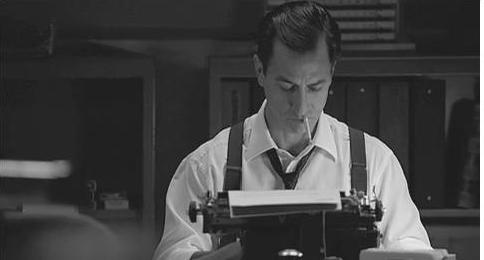
Watching Good Night, and Good Luck (2005, George Clooney)


"This might just do nobody any good. At the end of this discourse a few people may accuse this reporter of fouling his own comfortable nest and your organization may be accused of having given hospitality to heretical and even dangerous ideas. But the elaborate structure of networks advertising agencies, and sponsors will not be shaken or altered. It is my desire, if not my duty, to try to talk to you journeymen with some candor about what is happening to radio and television. And if what I say is responsible, I alone am responsible for the saying of it. Our history will be what we make of it. And if there are any historians about or years from now and there should be preserved the kinescopes of one week of all three networks they will there find recorded in black and white, and in color evidence of decadence, escapism and insulation from the realities of the world in which we live. We are currently wealthy, fat, comfortable, and complacent. We have a built-in allergy tounpleasant or disturbing information. Our mass media reflect this. But unless we get up offour fat surpluses and recognize that television in the main is being used to distract, delude, amuse, and insulate us then television and those who finance it those who look at itand those who work at it may see a totally different picture too late."

You might feel that these words decribe the current time, but it is not so. This is the speech given by Edward R. Murrow at the beginning of of the film Good Night, and Good Luck. It is a film that became famous because George Clooney directed it.

This is a film about the mass media (TV), but it is also a film about politics. About deluding, misleading and giving false evidence. And if you think "terrorist" instead of "communist" every time the latter word is spoken in the film, this black-and-white mastery becomes hauntingly contemporary.

"I began by saying that our history will be what we make of it. If we go on as we are then history will take its revenge, and retribution will not limp in catching up with us. Just once in a while, let us exalt the importance of ideas and information.

Let us dream to the extent of saying that on a given Sunday night the time normally occupied by Ed Sullivan is given over to a clinical survey on the state of American education. And a week or two later, the time normally used by Steve Allen is devoted to a thorough-going study of American policy in the Middle East. Would the corporate image of their respective sponsors be damaged? Would the shareholders rise up in their wrath and complain? Would anything happen other than a few million people would have received a little illumination on subjects that may well determine the future of this country and therefore the future of the corporations?

To those who say people wouldn't look; they wouldn't be interested; they're too complacent, indifferent and insulated, I can only reply: There is, in one reporter's opinion, considerable evidence against that contention. But even if they are right, what have they got to lose? Because if they are right, and this instrument is good for nothing but to entertain, amuse and insulate, then the tube is flickering now and we will soon see that the whole struggle is lost. This instrument can teach, it can illuminate; yes, and it can even inspire. But it can do so only to the extent that humans are determined to use it to those ends. Otherwise it is merely wires and lights in a box. Good night, and good luck."

And if the above two quotes aren't enought to convince you to watch the film, then it might just not be a film for you. Sadly, many people left mid-way through the screening of this film on Sunday.

Labels:

posted by Nadezhda | 15:39 | 0 comments